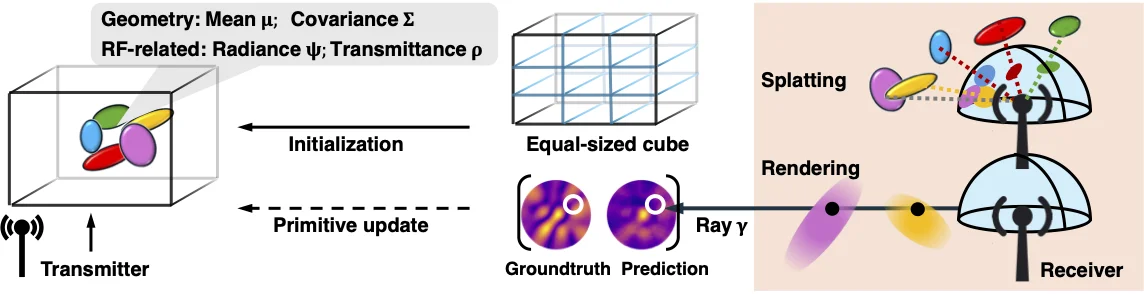
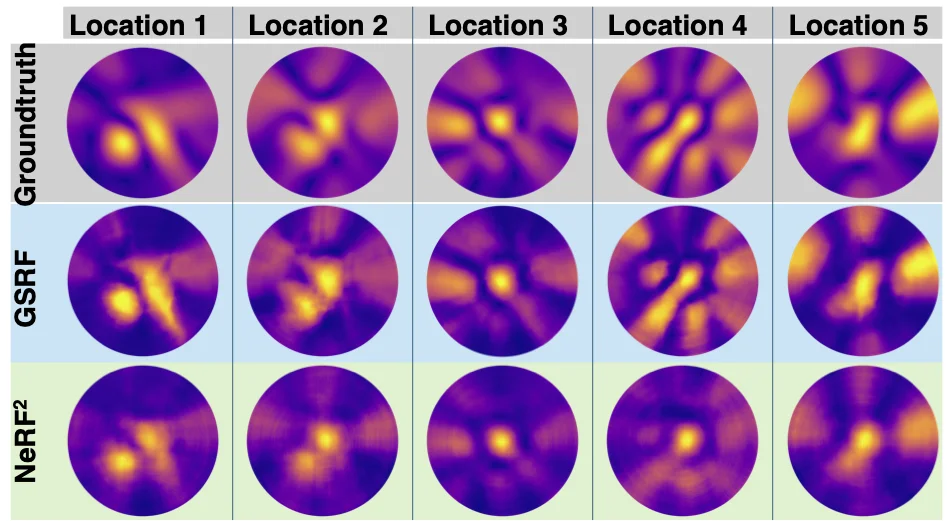
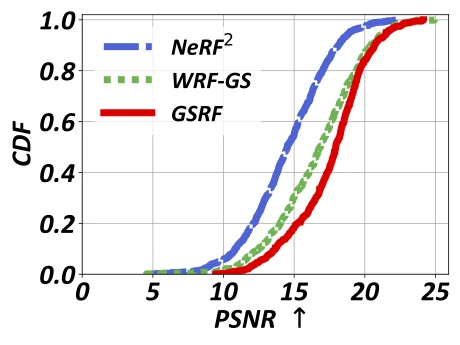
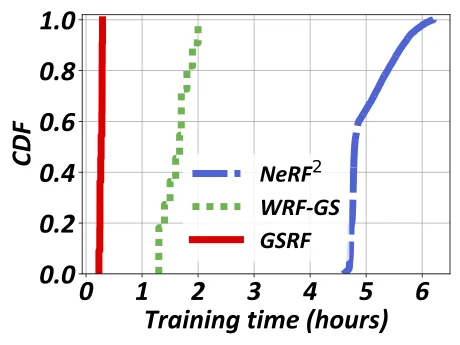
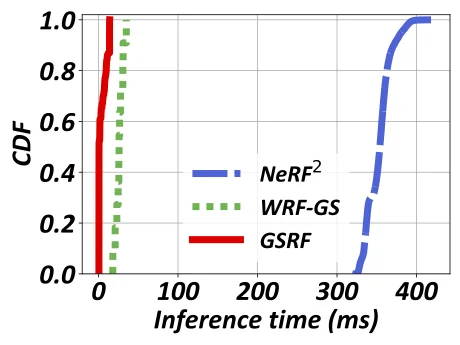
Synthesizing radio-frequency (RF) data given the transmitter and receiver positions, e.g., received signal strength indicator (RSSI), is critical for wireless networking and sensing applications, such as indoor localization. However, it remains challenging due to complex propagation interactions, including reflection, diffraction, and scattering. State-of-the-art neural radiance field (NeRF)-based methods achieve high-fidelity RF data synthesis but are limited by long training times and high inference latency. We introduce GSRF, a framework that extends 3D Gaussian Splatting (3DGS) from the optical domain to the RF domain, enabling efficient RF data synthesis. GSRF realizes this adaptation through three key innovations: First, it introduces complex-valued 3D Gaussians with a hybrid Fourier–Legendre basis to model directional and phase-dependent radiance. Second, it employs orthographic splatting for efficient ray–Gaussian intersection identification. Third, it incorporates a complex-valued ray tracing algorithm, executed on RF-customized CUDA kernels and grounded in wavefront propagation principles, to synthesize RF data in real time. Evaluated across various RF technologies, GSRF preserves high-fidelity RF data synthesis while achieving significant improvements in training efficiency, shorter training time, and reduced inference latency.