Overview
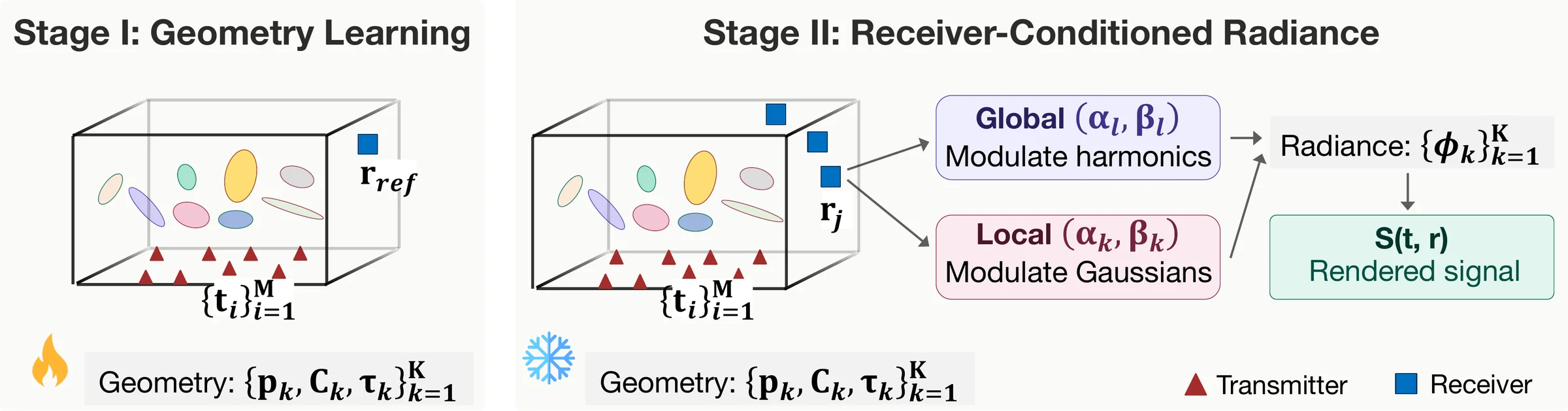
RxGS synthesizes RF data (RSSI, spatial spectrum, and CSI) at any transmitter and any receiver in a scene with a single model. The 3D Gaussian attributes split into two groups: position pk, covariance Ck, and transmittance τk describe where scatterers are and how they attenuate signals, so they do not depend on the receiver; the radiance coefficients φk encode the directional signal response and change with receiver position.
Abstract
Radio-frequency (RF) data synthesis predicts the received signal given transmitter and receiver positions, and is essential for wireless applications. Recent 3D Gaussian Splatting (3DGS)-based methods achieve efficient synthesis at any transmitter but only for a fixed receiver. Therefore, supporting N receivers in one scene requires N independent models and precludes prediction at unseen receivers. We present RxGS, which achieves receiver-generalizable synthesis within a single unified model.
Our key insight is that scene geometry is receiver-independent while directional radiance is not: a first stage learns shared 3D Gaussian geometry, and a second stage freezes it and learns directional radiance conditioned on receiver position. A global conditioning branch captures shared receiver-dependent effects across the scene, while a local branch models per-scatterer variations from the receiver's geometry and occlusion. A multi-receiver CUDA rasterizer further batches rendering across all N receivers. Evaluated across various RF datasets, RxGS matches or improves over per-receiver baselines with a single shared model and generalizes to receivers unseen during training within the scene, cutting training cost by up to 45×, inference cost by 7.6×, and storage by N×.
Qualitative Results
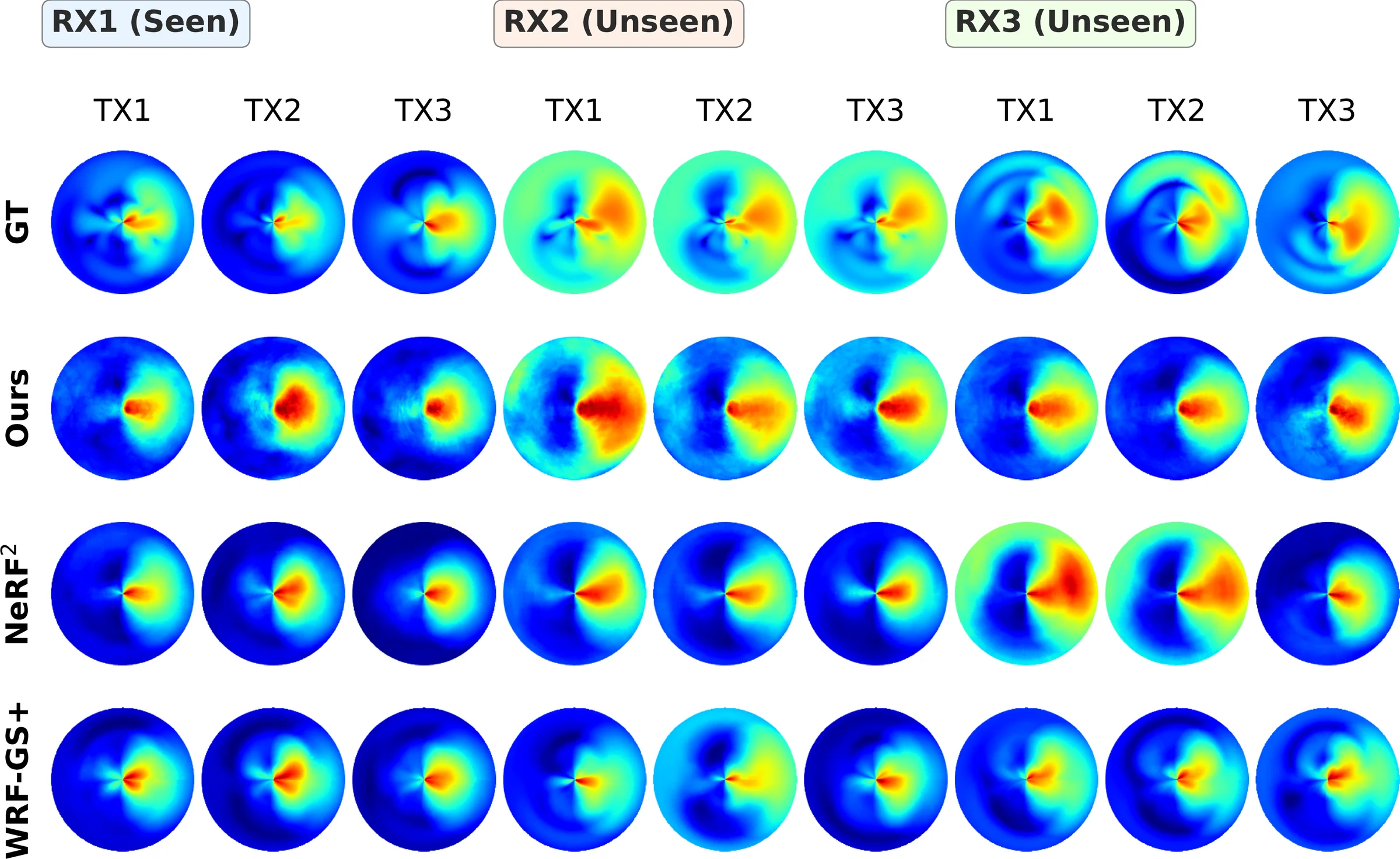
Spatial spectra predicted at three receivers for three transmitters each. RxGS gives the closest match to the ground truth at the unseen receivers. NeRF2 predictions are overly smooth and miss sharp directional peaks, and WRF-GS+, which cannot generalize, falls back to the nearest seen receiver's checkpoint.
Generalization to Unseen Receivers
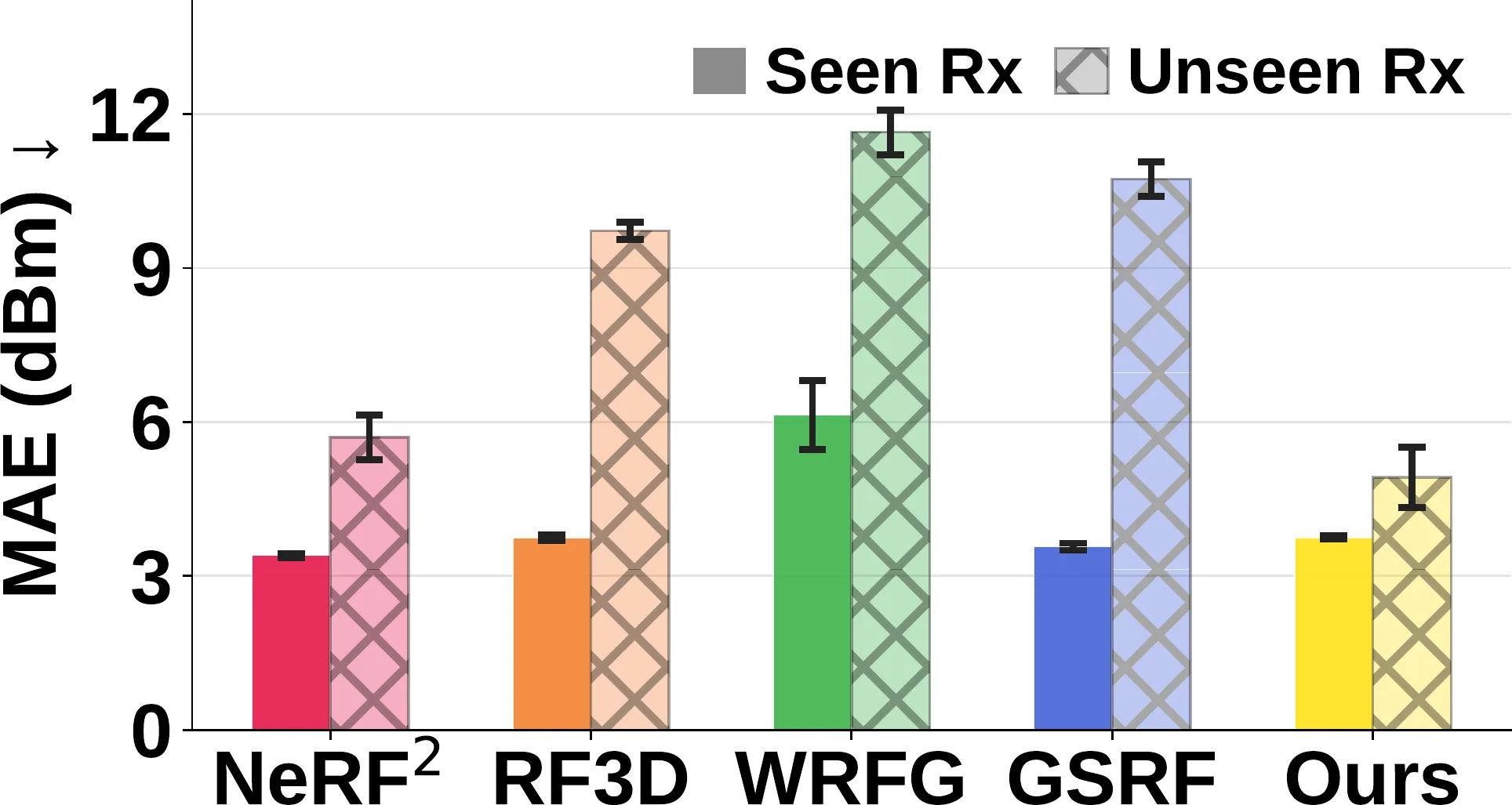
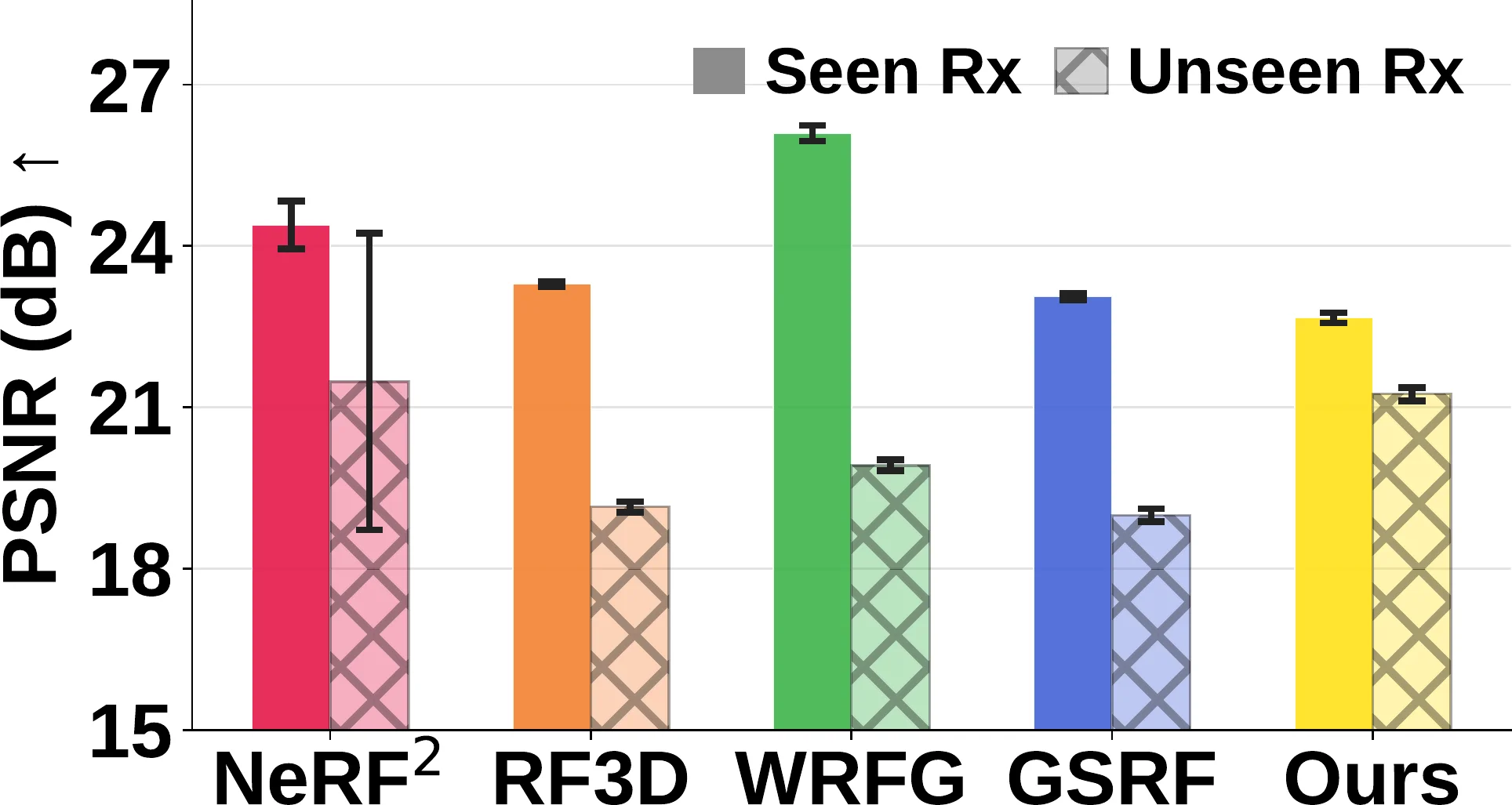
The 21 receivers are split into 3 folds of 7; each model is trained on 14 receivers and evaluated on all 21. Per-receiver 3DGS baselines (RF-3DGS, WRF-GS+, GSRF) fail at receivers they never observed: BLE RSSI error rises from 3.6–6.1 dBm to 9.7–11.6 dBm. RxGS reaches the lowest unseen error of 4.92 dBm on BLE while matching the best seen error at 3.75 dBm, and stays within 2 dB of its seen performance on both datasets.
Efficiency
Cost of training and serving N = 21 receivers on the RFID spectrum dataset. Replacing N per-receiver models with one shared model trains 7–45× faster. The multi-receiver rasterizer renders all receivers in one batched CUDA call, making inference up to 7.6× faster than 3DGS baselines and 60–1900× faster than NeRF2 and GRaF. Storage shrinks by roughly 21×.
| Method | Train (h) | Inference (ms) | Storage (MB) |
|---|---|---|---|
| NeRF2 | 14.3 | 2436.4 | 2.6 |
| GRaF | 16.2 | 59891.4 | 143.7 |
| RF-3DGS | 2.8 | 156.4 | 181.9 |
| RF-3DGS + RxGS | 0.4 | 35.3 | 8.8 |
| GSRF | 5.5 | 238.1 | 548.0 |
| GSRF + RxGS | 0.6 | 31.2 | 26.1 |
| WRF-GS+ | 13.6 | 52.4 | 75.6 |
| WRF-GS+ + RxGS | 0.3 | 42.5 | 3.2 |
Application: Sparse-Deployment BLE Localization
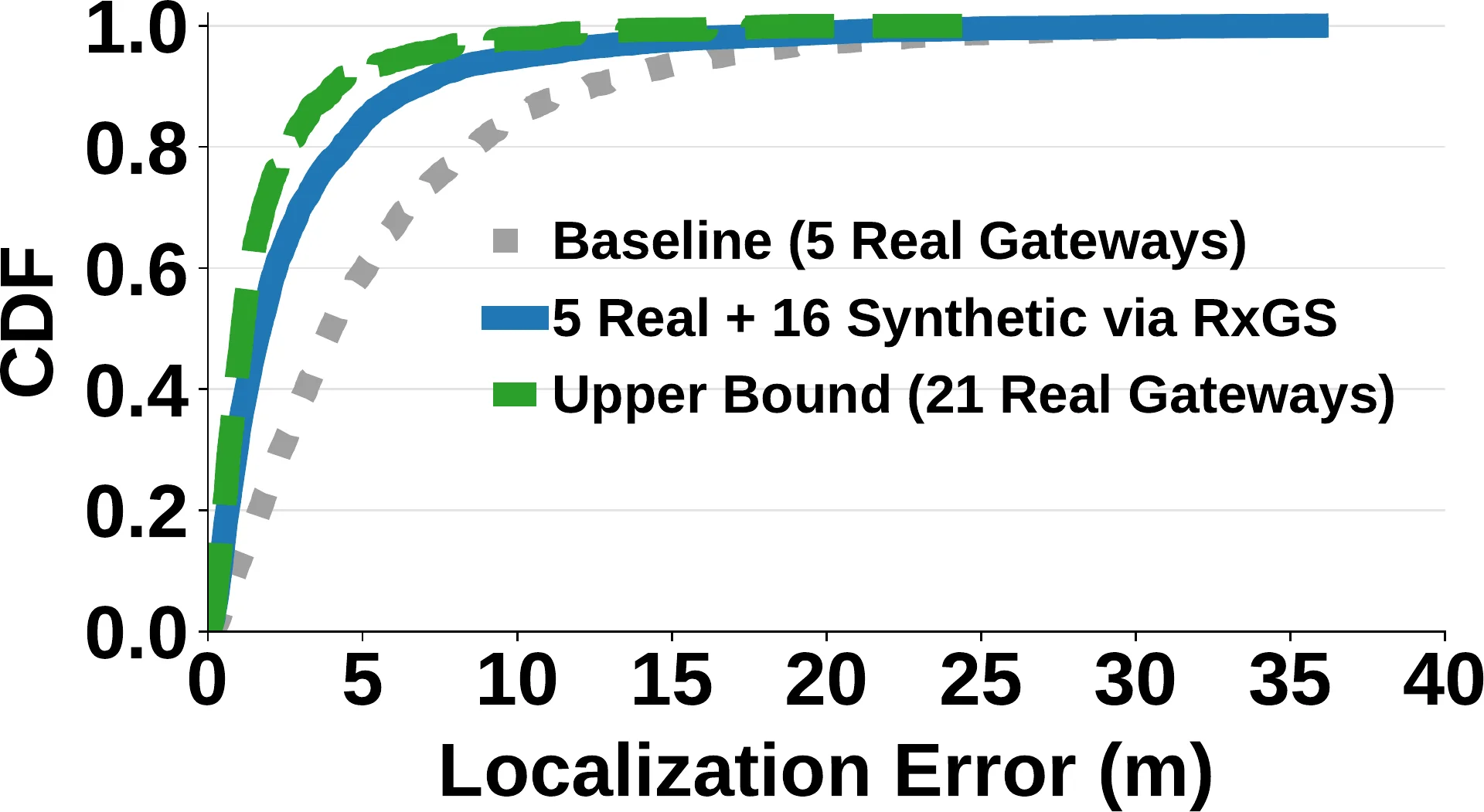
Only 5 gateways are physically installed, and RxGS synthesizes RSSI at the remaining 16 positions to form a 21-dimensional fingerprint. Each of the 1,200 test transmitters is localized with weighted K-nearest neighbors (K = 5). The synthesized fingerprints reduce the mean error from 5.61 m to 2.98 m, a 47% improvement that closes 71% of the gap to the full 21-gateway deployment (1.91 m).
BibTeX
@inproceedings{yang2026rxgs,
  title={{RxGS: Receiver-Generalizable 3D Gaussian Splatting for Radio-Frequency Data Synthesis}},
  author={Yang, Kang and Srivastava, Mani},
  booktitle={Advances in Neural Information Processing Systems (NeurIPS)},
  year={2026}
}